
“What if workforces had no limits?..” This Salesforce's brand-new motto, whispered by Matthew McConaughey at the opening of the annual Dreamforce conference, invites us to imagine a future full of new possibilities made possible by the new big thing, Agentforce. What is this Agentforce about?
Since large language models (LLMs) entered our everyday lives, our work routines have changed significantly, to say the least.
Yes, there are many tasks we can delegate to machines. And, as time passes, more people are willing to delegate their work – to machines. A good thing or a bad tendency? We will leave this controversial discussion outside the scope of this blog.
Here is an attempt to overview the tech capabilities of the so-called Agentic AI, and more specifically, the Salesforce-powered Agentforce.
What is this Agentforce about? According to Dreamforce’s welcoming video, it’s “about building a world where humans and digital agents work together, where empathy meets efficiency, where intelligence is autonomous,” etc.
Let's figure out what's behind these beautiful words.
Agentforce in numbers
Although a rather new thing on the market, Agentforce has already been battle-tested by over 12,500 companies across 39 countries (Feb 13, 2026). The results are promising at least as far as Salesforce reports it (we still have to wait for independent surveys to be published).
According to their estimates, Agentforce implementation translates into the following numbers:
- 12K+ organizations leverage Agentforce to optimize their workforce;
- 34% report an increase in productivity due to generative or agentic AI;
- 84% say AI has improved customer satisfaction and ROI;
- $100M in annualized customer cost savings;
- 12 AI agents, on average, are currently used by enterprises.
5 simple Agentforce use cases
How does Agentforce actually work? How do you implement it into your work routine so that it increases productivity, not hassle?
- Support: While chatbots have been controversial, agents with access to all the necessary information (updated in real-time) are far more efficient. Read the Pandora case study; according to SF, they achieved significant results: 40,000 monthly conversations processed by Agentforce, 60% of calls redirected automatically, and a 10% increase in customer loyalty thanks to a customer-centric approach.
- Internal IT helpdesk: Things that always take up a lot of time and resources for organizations; a simple request like "I can't access my work email, or I forgot my password" can lead to internal bureaucracy or paperwork. With an agent, it's resolved in seconds.
- Booking: Canceling a booking is always a hassle, but not when you have agents. Just tell the agent "Cancel my booking," and it will find your reservation, check it, cancel it, initiate the refund process, update all the data and records, and notify you in seconds. Read the Finnair case study: leveraging Agentforce, they managed to increase the number of conversations by 7 times, with a customer request resolution rate of 80%.
- Order status: Everything related to orders involves quite a lot of numbers, which can be easy to be confused by. Just ask the agent “Where is my order?” and it will easily return all the necessary information to you, and notify you in a timely manner. Read the Falabella case study: leveraging Agentforce, they were able to triple the number of conversations and, with two and a half million LLM requests per month, achieve four or five stars for the quality of their support in 70 percent of cases.
- RMA: Another procedure that takes a lot of time and effort, but involves a series of routine processes that are easily handled by an agent. The agent will check the return policies, set up return automation, and initiate the return process.
Salesforce as AI trailblazer
A little background. Salesforce has long positioned itself as the #1 CRM + SaaS for enterprises, regularly adding new clouds of varying profiles, areas, and specifications to its portfolio (Service Cloud, Sales Cloud, and more niched the Net Zero ESG-focused Cloud).
But the laurels of being the best CRM system probably weren't enough, or perhaps maintaining the status quo wasn't worth it.
As soon as the first LLMs began to appear (and while many of the tech giants were still hesitating about how deeply to go into this process), Salesforce (as if it was just waiting for it) began actively pursuing implementation, and over time became one of the most prominent evangelists and heralds of AI adoption.
In any case, Salesforce has always championed the idea that too much automation is never enough: they have spent years building an automated, well-developed infrastructure for enterprises, with the ability to connect to any cloud for any business purpose.
Thus, by the time LLMs appeared, they already had a fully prepared, enterprise-grade automated infrastructure - a fertile ground for any innovation.
And it wasn't just rhetoric: Salesforce very quickly moved from words to action.
The rise of the LLMs
Few expected that a technological revolution would look like this: people sticking to chat windows, typing texts; sci-fi movies had prepared us for a somewhat different environment.
And yet, it happened this way. And perhaps the most important thing isn't the interface itself, but the essence: we're finally communicating with a machine in natural language, and it understands us pretty well (well, mostly).
People use AI in so many peculiar ways... What interests us is this becoming of chatbots as agents: the use of chatbots as advisors, assistants, and, finally, as colleagues and co-workers who can contribute equally with you; for now, for convenience, this entire segment is called AI agents.
Chatbot vs AI Agent
Unlike a chatbot, which can only chat and know only what it reads on the Internet, an AI agent has hands (tools and applications) with which it can do things in the real world.
AI Agents
Perfect assistants-coworkers or a hallucinating mess? It depends on how well these agents are configured.
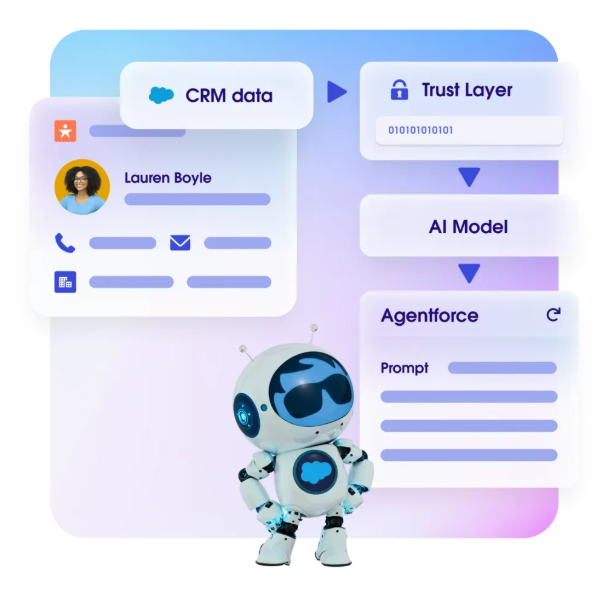
In the end, it all comes down to permissions and data (also, what Salesforce calls a Trust layer): how much you're willing to share, and how much you deem necessary to delegate.
However, what if these permissions and guardrails are easily configurable? This capability means you can customize the scope of work, the algorithms, and the access boundaries yourself.
How do you build your AI Agents? What do they consist of?
- Role: We often think of AI as some kind of divine intelligence that permeates all areas of life and can answer any question off the cuff. It's clearly much more effective, though, to use AI as a highly specialized agent, focused only on a specific set of tasks.
- Data: Context matters, context is the most important thing; data is the fuel you feed your machine. The effectiveness of your agent depends on how high-quality, relevant, and appropriate this source is to the situation.
- Actions: Your agent-employee's permissions are configured in the same way as a real employee. There is a set of workflows it must complete. Technically, this all depends on the flows, Apex code, and MuleSoft API calls.
- Guardrails: In addition to what you know the agent should do, you can configure what it shouldn't do; what data it should be strictly forbidden to access, and what non-working prompts should be ignored. Technically, all of this is configured using role permissions, the data model, and the business logic.
- Channels: What is your agent's habitat? Determine your agent's work location, environment, medium, what contacts they have access to, and through what channels your agent will interact (SMS, WhatsApp, Slack, or voice).
Salesforce goes Agentforce
The problem with LLM today is that it is like a giant library that can talk but can't do anything — it knows anything that can be read on the internet, but it can't actually do anything for your business.
Agentic AI changes the game by giving it somewhat a set of hands. Instead of just chatting, these agents can call tools and applications to step out into the real world and actually get your work done.
Let's glance at what these tools and applications are behind Agentforce, and how it works altogether.
What is an AI agent in the context of Agentforce?
In the context of Agentforce, an agent is your AI colleague or employee who can work autonomously, reason, make best decisions for your project, initiate, and complete tasks of varying complexity leveraging Salesforce data to which you've granted an access.
Is Agentforce a somewhat rebranded Einstein Copilot?
Yes and no. In some ways, this is truly an evolution of the Einstein product line. On the other hand, it's a breakthrough shift from reactive assistance to a more autonomous, automated agency: the agent can reason, make decisions independently, and start and finish workflows.
What is the Einstein Trust Layer?
The Einstein Trust Layer is a secure AI architecture within Salesforce that protects sensitive data by obscuring personal information and enforcing a zero-data-retention policy when working with LLM providers.
What is Agentforce Atlas?
Atlas is an advanced reasoning engine; it uses a continuous loop to analyze user intent, plan workflows, and execute tasks. It uses real-time data to ensure contextual accuracy of agent actions while adhering to strict security rules.
What is Agentforce 360 Platform?
Agentforce 360 Platform is a unified platform for creating, running, and managing AI agents and applications, unifying all customer and business data across your organization.
- Customer 360: Customer 360 is a suite of AI-powered integrated apps and data services from Salesforce, that enable you to create a unified customer view in real-time.
- Data 360: Data 360 is a real-time data engine (ex-Data Cloud) that aggregates, processes, and activates customer and business data from any source into a single, easy-to-use Customer 360 profile.
What is prompt engineering in the context of Agentforce?
Prompt engineering is the foundation for communicating with agents; this is the way to configure them using natural language in Agentforce Studio. Using prompts, you create certain templates (roadmaps according to which your agents will develop) for your AI coworkers, assigning instructions, context, restrictions, and access to particular CRM data. Ensuring that this work is precise, and automated.
What is Agentforce Studio?
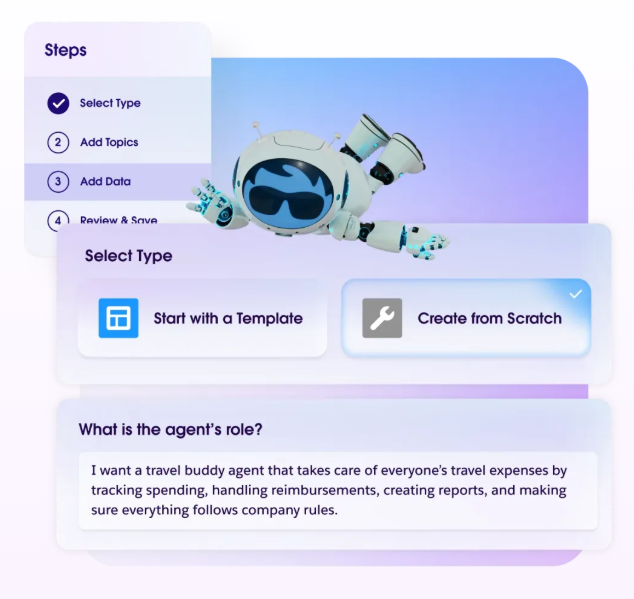
Agentforce Studio is a user-friendly UI that allows you to configure and customize your agents using natural language (a low-code to no-code environment to be more precise).
It's essentially a workshop where Salesforce developers and administrators build their digital colleagues.
This workspace, Agentforce Studio, consists of three component layers or levels, each of which can be configured.
- Agent Builder: A low-code to no-code interface for setting operating parameters, describing the agent's job responsibilities.
Topic – a user specifies a particular domain here (as we said earlier, the narrower, the more effective, the greater the impact).
Reasoning – configurators have the ability to evaluate the agent's thought process in real-time, how it reasons, and why it makes certain choices (Atlas's workflow is a “brain” behind Salesforce’s Agentforce).
- Prompt Builder: This is the part of the interface shell where configurators actually assign tasks to the agents, specify how they will act, and can manipulate certain Salesforce data.
- Model Builder: Here you can select a specific language model on which to build your agent (you can choose Salesforce models or any of the currently popular OpenAI, Gemini, or Claude models).
Agentforce also employs monitoring options for the performance and accuracy of the model and a checking option for hallucinations.
Bottom Line
Your trust or distrust in Agentforce is likely to be determined by your overall attitude toward AI's impact. If you're an AI optimist, you likely have no doubt about the effectiveness of Agentforce.
Ultimately when it comes to language models, much, if not everything, comes down to how well, using natural language, you can articulate what you need to do.
Salesforce publishes plenty of case studies regarding successfully implementing Agentforce into workflows. We will continue to examine the impact of Agentforce, and grow our expertise.
Stay tuned, and make sure to contact us if you plan to enhance your enterprise with Agentforce.


